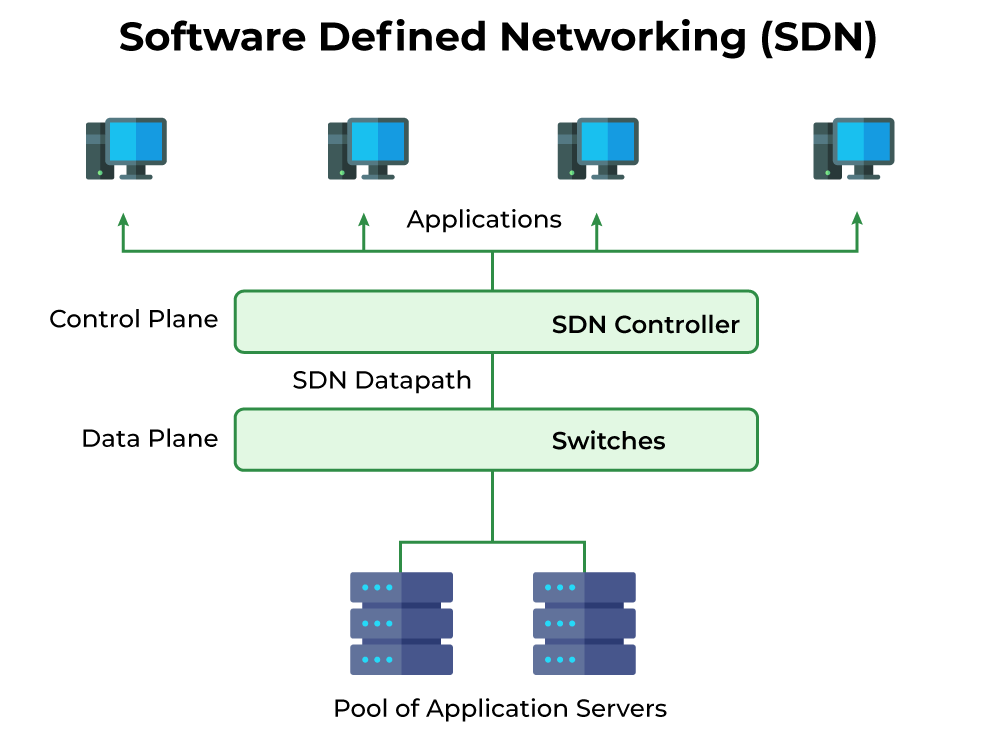
Traditional networks are built on a monolithic architecture, where the control plane and the data plane are tightly coupled. This means that the control plane is responsible for both configuring the network and forwarding traffic.
SDN (Software-Defined Networking) is a new way of networking that decouples the control plane from the data plane. This allows the control plane to be centralized and programmable, while the data plane remains distributed.
SDN has a number of benefits, including:
•Increased agility: SDN makes it easier to deploy new network services and applications. This is because the control plane can be programmed to dynamically configure the network.
•Improved performance: SDN can improve the performance of networks by optimizing traffic flows. This is because the control plane can make decisions about how to route traffic based on real-time conditions.
•Reduced costs: SDN can help to reduce costs by making it easier to manage and operate networks. This is because the control plane can be used to automate tasks such as provisioning and monitoring
SDN is still a relatively new technology, but it is gaining popularity in the networking industry. This is because SDN offers a number of benefits that can help organizations to improve the performance, agility, and cost-effectiveness of their networks.
Here are some of the key concepts of SDN:
•The control plane: The control plane is responsible for configuring the network and forwarding traffic. In a traditional network, the control plane is tightly coupled with the data plane. However, in an SDN network, the control plane is decoupled from the data plane and is implemented as software.
•The data plane: The data plane is responsible for forwarding traffic. In an SDN network, the data plane is implemented in hardware.
The SDN controller: The SDN controller is a software application that manages the control plane. The SDN controller receives requests from applications and devices, and it uses these requests to configure the network.
•The SDN API: The SDN API is a set of interfaces that allow applications and devices to communicate with the SDN controller. The SDN API allows applications and devices to request network resources and to monitor the network
 𝙽𝚎𝚡𝚝 𝙶𝚎𝚗𝚎𝚛𝚊𝚝𝚒𝚘𝚗 𝚃𝚎𝚌𝚑𝚗𝚘𝚕𝚘𝚐𝚢