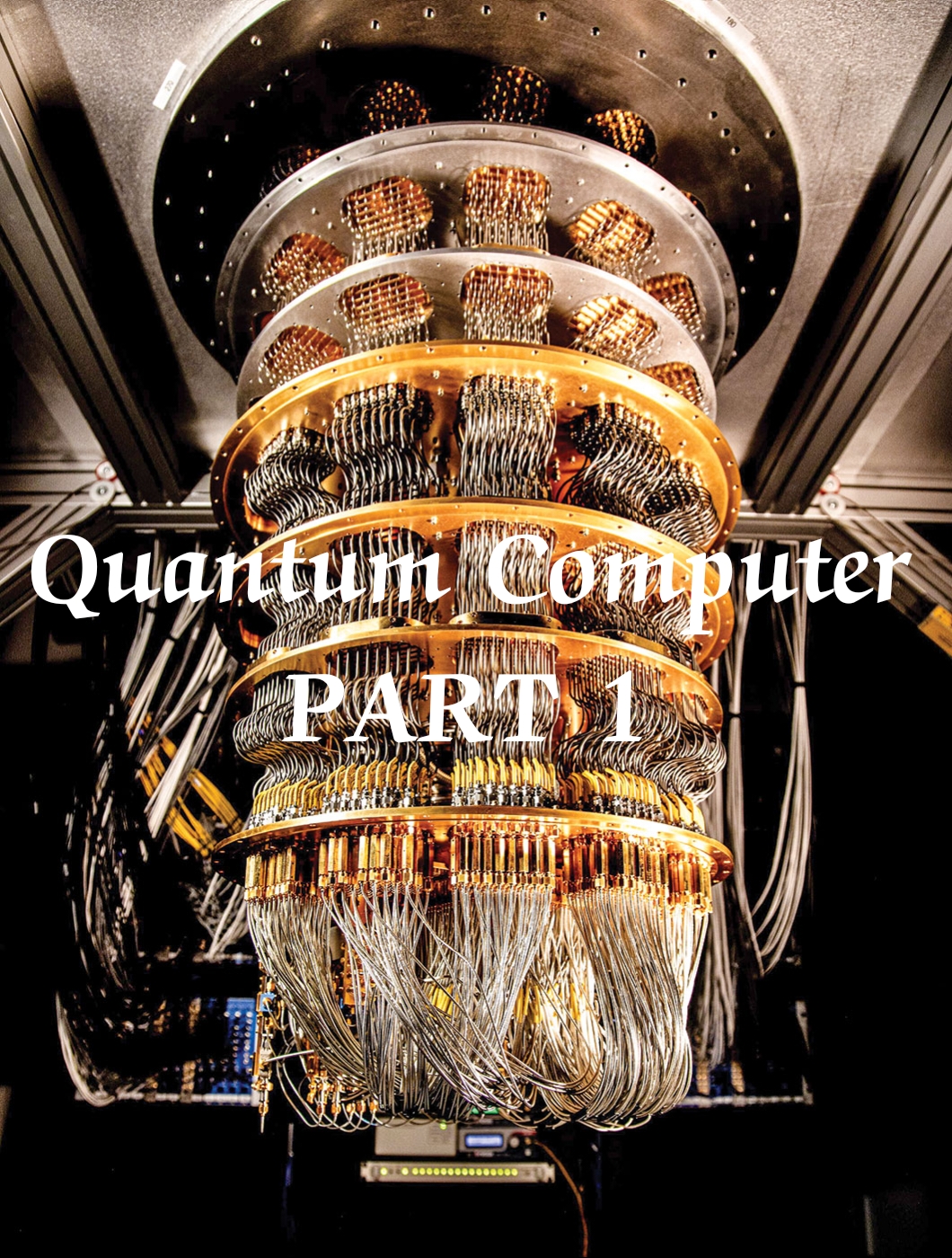
PART 1
/*I was impressed by quantum computers.So I was sharing my experience by this blog.Hope you learn from my blog*/
Quantum Computer
- Quantum computers use qubits (quantum bits) instead of classical bits, which allows them to perform calculations much faster.
- The first theoretical concepts of a quantum computer were introduced by physicist Richard Feynman in the 1980s.
- Quantum computers use quantum bits, or qubits, instead of classical bits. Qubits can exist in multiple states simultaneously, allowing for exponentially faster computation.
- Quantum computers have the potential to solve problems that are practically impossible for classical computers to solve, such as simulating complex chemical reactions or cracking encryption codes.
- The first quantum computer was built in 1998 by Isaac Chuang and his team at MIT.
- Quantum computers require special cooling techniques to maintain the quantum state of their qubits. Most quantum computers are kept at extremely low temperatures, close to absolute zero (-273.15°C).
- The term “quantum computing” was coined by physicist Paul Benioff in 1981.
- One of the most well-known quantum algorithms is Shor’s algorithm, which can factor large numbers exponentially faster than classical algorithms.
- The largest number ever factored by a quantum computer using Shor’s algorithm is 21.
- Quantum computers are not just faster than classical computers – they are also fundamentally different in the way they operate, using principles of quantum mechanics.
- The basic unit of quantum computing is the qubit, which can exist in two states at once, known as superposition.
- Quantum computers are also capable of quantum entanglement, a phenomenon in which two or more qubits become linked and can share information instantaneously over large distances.
- Microsoft has developed a quantum programming language called Q#, which allows developers to write programs for quantum computers.
- IBM has developed a quantum computer that is accessible over the cloud, allowing developers and researchers to experiment with quantum computing without needing access to expensive hardware.
- The first quantum computer conference, the Conference on Quantum Computation, Communication, and Cryptography, was held in 1994.
- The first commercial quantum computer was launched in 2011 by D-Wave Systems.
- The Google quantum computer known as Sycamore made headlines in 2019 when it reportedly achieved “quantum supremacy” by completing a calculation that would take a classical computer 10,000 years to complete in just 3 minutes and 20 seconds.
- One of the biggest challenges in quantum computing is reducing the error rate of qubits, which can be susceptible to errors from environmental noise.
- Quantum computers have potential applications in fields such as drug discovery, financial modeling, and optimization problems.
- The race to develop a practical quantum computer has attracted significant investment from both private companies and governments.
- China is one of the leaders in quantum computing research, with the Chinese government investing billions of dollars in quantum research.
- Many experts predict that quantum computing will be a transformative technology that will change the way we solve problems and process information in the future.
/*Thanks for visiting my blog*/
 𝙽𝚎𝚡𝚝 𝙶𝚎𝚗𝚎𝚛𝚊𝚝𝚒𝚘𝚗 𝚃𝚎𝚌𝚑𝚗𝚘𝚕𝚘𝚐𝚢